System Architecture
Couchbase FHIR CE is a modular, containerized platform built for performance, scalability, and interoperability.
It consists of three core containers, each with a dedicated role in the system:
- FHIR Server – REST API, validation, persistence
- FHIR Admin – Frontend dashboard & management UI
- HAProxy – Smart load balancer, multi-tenant router, and metrics gateway
Together, they form a complete FHIR platform that connects seamlessly to Couchbase Server or Capella.
High-Level Architecture
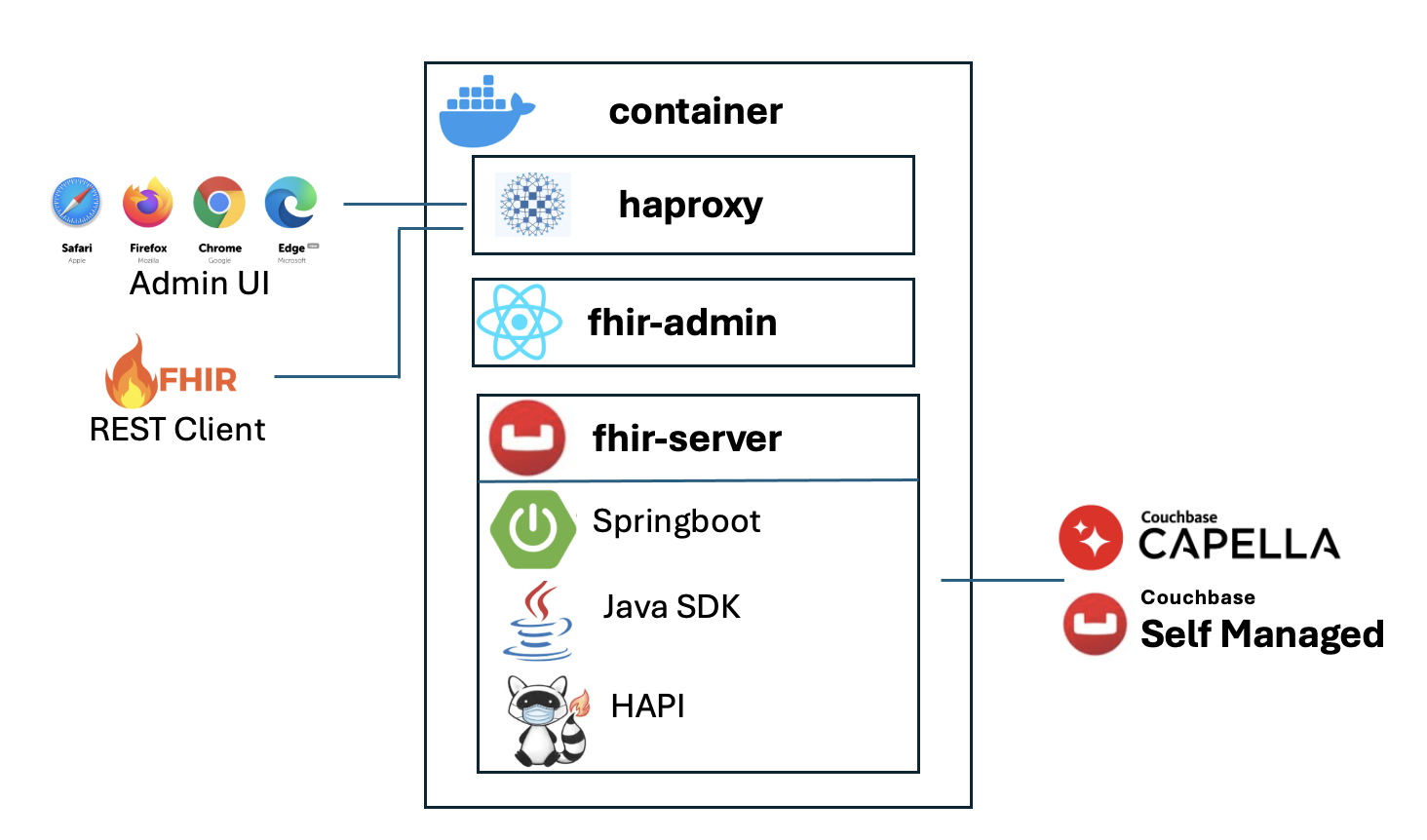
Core building blocks:
- One or more Couchbase clusters (Self‑Managed or Capella)
- FHIR Server container (Spring Boot + HAPI FHIR)
- Admin UI container (React + MUI)
- HAProxy container (routing and metrics)
- Optional: synthetic data generators, monitoring/observability stack
Component Breakdown
FHIR Server (fhir-server)
The core of the platform. Implements the FHIR RESTful API.
- Built with Spring Boot and HAPI FHIR
- Supports FHIR R4 and US Core Implementation Guide (IG)
- Handles CRUD, search, validation, and transaction bundles
- Integrates with Couchbase SDK for data access
- Supports:
_include,_revinclude,$everything- Pagination and sorting
- US Core validation via HAPI’s validator + NPM packages
- Stores all resources as native JSON documents in Couchbase
FHIR-Bucket:
- One bucket per cluster for FHIR named fhir
- Layout
fhir
├── Admin
│	├── cache
│	├── clients
│	├── config
│	├── tokens
│	└── users
├── Resources
│	├── Patient
│	├── Observation
│	├── Encounter
│	├── Condition
│	├── Procedure
│	├── MedicationRequest
│	├── DiagnosticReport
│	├── DocumentReference
│	├── Immunization
│	├── ServiceRequest
│	├── General
│	├── Versions
│	└── Tombstones
├── FTS Indexes
└── GSI Indexess
Observability:
- Metrics via Micrometer + Spring Actuator
- Exposes
/actuator/metrics,/actuator/health,/actuator/prometheus
FHIR Admin (fhir-admin)
A React-based management dashboard for administrators and developers.
- Built with React 19, MUI, Zustand, React Query, and Recharts
- Provides:
- Real-time cluster metrics (CPU, memory, disk)
- FTS index browser and status viewer
- Query dashboards for testing and benchmarking
- Validation logs and tenant configuration
- Communicates with backend APIs for metrics and management
Features:
- Light/Dark theme
- Monaco JSON editor
- Time-based dashboards with minute/hour/day sampling
- HAProxy and FHIR metrics visualization
HAProxy (haproxy)
A lightweight, high-performance load balancer and router.
- Routes incoming FHIR REST calls to the correct tenant bucket
- Can route by path prefix (e.g.,
/fhir/{tenant}/...) - Collects request-level metrics:
- Active connections, response times, ops/sec
- Supports:
- SSL/TLS termination (optional)
- Multi-node scaling
- Can be replaced by other gateways (NGINX, Kong) in advanced setups
Couchbase Server / Capella
The underlying data platform.
- Stores all FHIR resources as JSON documents
- Organizes data by bucket / scope / collection
- Uses Full Text Search (FTS) indexes for query
- Provides KV, N1QL, FTS APIs
- Offers horizontal scalability and high availability
- Works on-prem (self-managed) or cloud (Capella)
Data Flow
[Client / App]
   ↓
  [HAProxy]
   ↓
 [FHIR Server] ⇆ [Couchbase Cluster]
   ↑
 [FHIR Admin Dashboard]
Request lifecycle (example: GET /fhir/acme/Patient?name=John):
- HAProxy routes the request to FHIR Server with tenant context
bucket=acme. - FHIR Server parses search params (HAPI FHIR) and builds an FTS query.
- Couchbase FTS returns matching document IDs.
- Couchbase KV fetches full JSON resources by ID (batched).
- FHIR Server assembles and returns a FHIR Bundle response.
- Admin UI polls metrics/logs from FHIR Server and HAProxy for observability.
Notes:
- FTS handles query semantics; KV guarantees low‑latency retrieval.
- Pagination can reuse cached ID sets to avoid repeated FTS cost.
Deployment Model
Couchbase FHIR CE is fully containerized and can run anywhere:
- Developer machines via
docker-compose - Cloud VMs (for example, AWS EC2) connecting to Couchbase Server
- Capella (managed Couchbase) with FHIR services deployed in your environment
- On‑prem Kubernetes or VM clusters
Typical docker-compose stack includes:
fhir-serverfhir-adminhaproxy
Optional add‑ons: Inferno validator, Redis (caching), Prometheus/Grafana (monitoring).
Architecture Principles
| Principle | Description |
|---|---|
| JSON‑native | Store FHIR resources as‑is; no transformation layer |
| Composable | Each service can be replaced independently |
| Observable | Metrics everywhere: server, HAProxy, Couchbase |
| Scalable | Horizontal scale via buckets, nodes, partitions |
| Secure | TLS‑ready; authentication/authorization pluggable |
Operational Considerations
- Scalability: Scale out by adding Couchbase nodes, partitioning FTS indexes, and horizontally scaling
fhir-serverpods/containers. - Security: Enable TLS end‑to‑end; restrict ingress via HAProxy; use least‑privilege DB credentials; isolate tenants per bucket.
- Observability: Expose Prometheus metrics from FHIR Server and HAProxy; visualize with Grafana; enable structured logs.
- Resilience: Run multiple
fhir-serverinstances behind HAProxy; configure health checks; set sensible timeouts and retries.
Summary
The modular design of Couchbase FHIR CE lets you:
- Deploy quickly with containers
- Scale predictably across tenants and data volume
- Operate with rich metrics and clear separation of concerns
- Achieve low‑latency, standards‑compliant FHIR operations via KV + FTS
Next Steps
- Understand how resources map to collections: FHIR Resources on Couchbase
- Learn how search is implemented: Indexing Strategy (FTS)